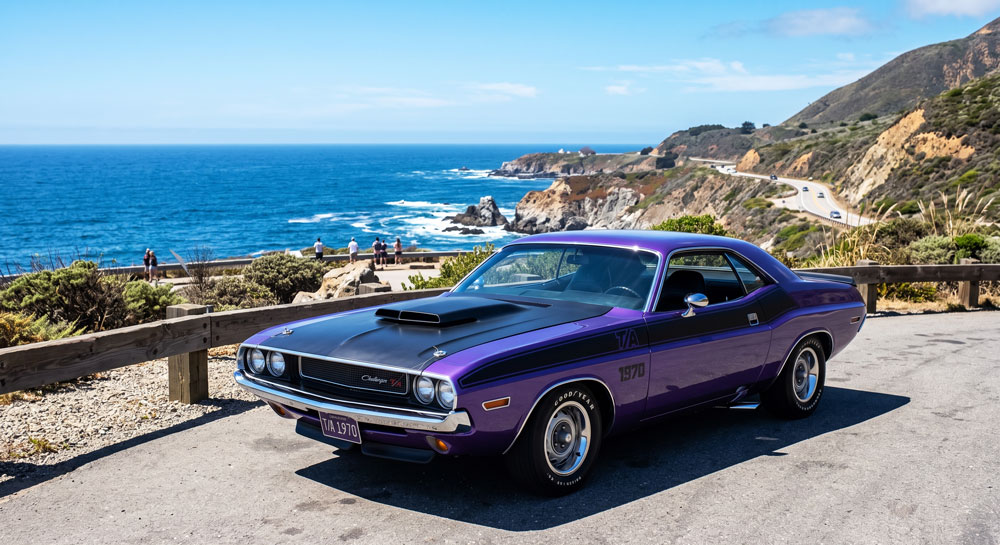
The 1970 Dodge Challenger T/A arrived with the colours, noise and visual drama expected from a golden-era muscle car, but its purpose went beyond straight-line speed. Developed to connect Dodge’s new Challenger with the Sports Car Club of America’s Trans-Am racing series, the T/A was a sharper, more specialized machine built around a high-revving small-block V8.
It was not the most powerful Challenger in the showroom. That distinction belonged to the big-block 440 and 426 Hemi models. Instead, the T/A offered something different: lighter front-end character, competition-inspired suspension and enough visual attitude to make even a Hemi look slightly overdressed.
Built for Trans-Am
Dodge introduced the Challenger for the 1970 model year, entering a pony-car battle already populated by the Ford Mustang, Chevrolet Camaro, Pontiac Firebird and AMC Javelin. The Trans-Am series had become an important stage on which manufacturers could prove that their cars were capable of more than quarter-mile heroics.
The Challenger T/A was created as the street-going counterpart to Dodge’s racing effort, much as the Plymouth AAR ’Cuda supported Plymouth’s entry. Race-prepared Challengers used engines reduced to meet the series’ five-litre displacement limit, while the production T/A retained the full 340-cubic-inch V8.
Dodge’s factory-backed cars were prepared by Ray Caldwell’s Autodynamics operation and raced by drivers including Sam Posey. The Challenger never dominated the championship, but its brief appearance helped produce one of the most distinctive road cars of the muscle era.
The 340 Six Pack
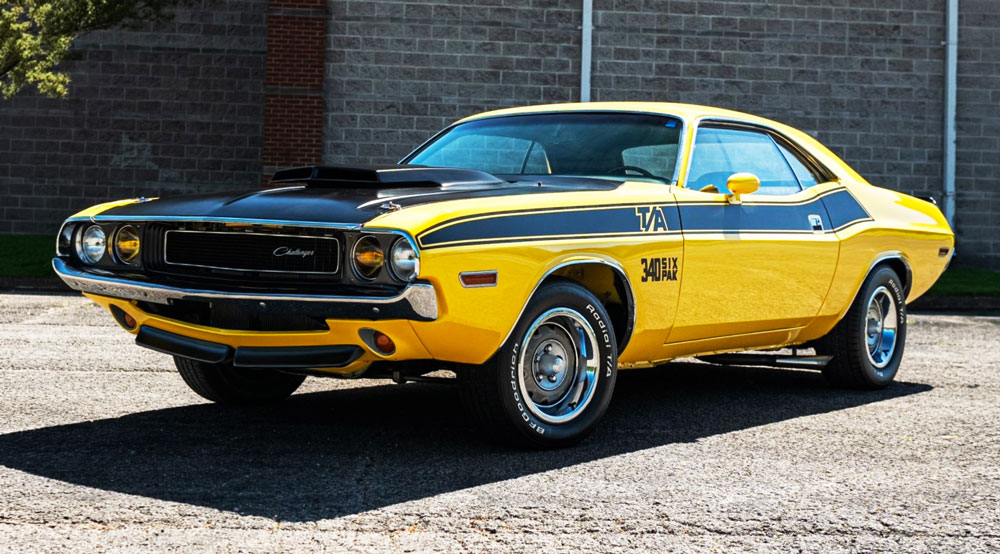
At the centre of the T/A was Chrysler’s 340-cubic-inch small-block V8, fitted with an aluminium intake manifold and three two-barrel Holley carburetors. Dodge called the arrangement the 340 Six Pack, while Plymouth used the Six Barrel name for its version.
Dodge rated the engine at 290 gross horsepower and 345 lb-ft of torque. Those figures placed it below the Challenger’s headline-grabbing big blocks, but numbers tell only part of the story. The 340 was more willing to rev, carried less weight over the front axle and gave the T/A a livelier personality than the heavier 440- and Hemi-powered models.
Drivers could choose a three-speed TorqueFlite automatic or a four-speed manual operated through one of Mopar’s famously theatrical pistol-grip shifters. Available rear-axle ratios allowed buyers to lean toward more relaxed road use or harder acceleration.
The engine breathed through an enormous scoop moulded into a matte-black fibreglass hood. Hood pins supplied the appropriate competition theatre, while the exhaust system exited through chrome-tipped outlets positioned ahead of the rear wheels. Subtle it was not. Subtle had apparently taken the afternoon off.
More Than a Stripe Package
The T/A’s mechanical upgrades extended beneath the body. Its Rallye suspension incorporated heavy-duty components, firmer rear springs and tuning intended to make the Challenger more capable when the road stopped being straight. Front disc brakes were standard.
One of its most recognizable features was its staggered Goodyear Polyglas tire arrangement. The T/A used E60-15 tires at the front and wider G60-15 rubber at the rear, giving it a nose-down, tail-high stance that became part of the car’s identity.
That setup did not transform the large Challenger into a delicate European sports car, and period accounts noted considerable understeer when it was pushed hard. Yet compared with the big-block cars, the lighter 340 helped the T/A feel more responsive and better suited to changing direction.
The result was an unusual Mopar: a muscle car that still delivered smoky acceleration but was conceived with corners somewhere in the conversation.
Designed to Be Seen
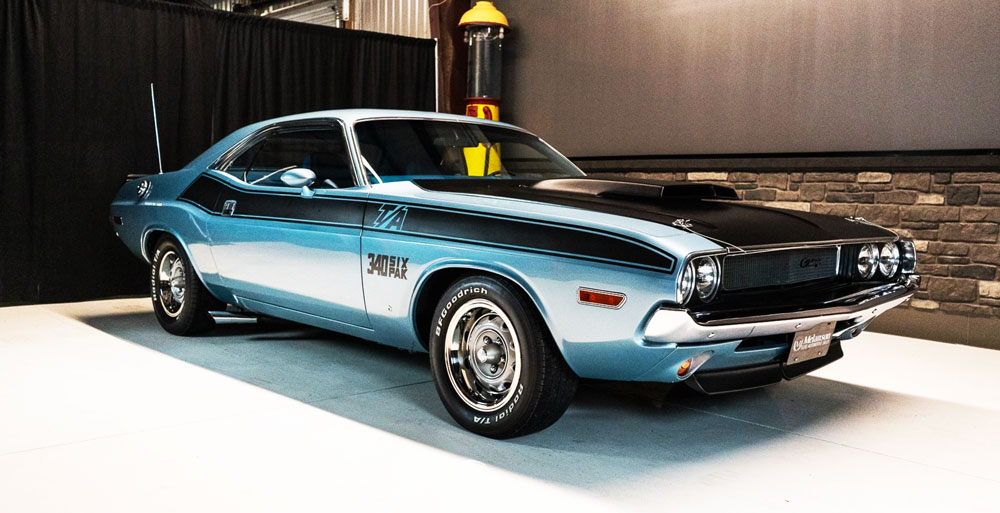
The standard Challenger was already one of the most dramatic shapes of 1970, with its long hood, recessed grille and broad rear quarters. The T/A turned every visual control a few clicks further.
Wide side graphics announced the model in enormous lettering, while front and rear spoilers reinforced its racing connection. The matte-black hood, oversized scoop, side-exit exhaust and staggered stance made the car identifiable from nearly any angle.
Dodge’s high-impact paint palette completed the transformation. Colours such as Plum Crazy, Sublime, Go Mango and Top Banana suited the T/A perfectly. These were not finishes chosen to disappear quietly into office parking lots; they were designed to attract attention from the next county.
Inside, the T/A remained recognizably Challenger. Buyers received the same spacious E-body cabin, deeply hooded instruments and broad dashboard found elsewhere in the range. Depending on the options selected, it could be relatively purposeful or surprisingly well equipped.
A One-Year Performance Statement
The original Challenger T/A was offered only for 1970. Dodge withdrew from the Trans-Am series after that season, and although a 1971 T/A was promoted in advance, it did not reach regular production.
Approximately 2,400 examples were built, making it far less common than a standard 1970 Challenger. Its one-year status, unique drivetrain and unmistakable appearance have since made it one of the most desirable small-block Mopars.
Authenticity is especially important today. The visual components can be reproduced, but a genuine T/A is identified through its vehicle coding, engine specification and supporting documentation. Original carburetion, air-cleaner assemblies, exhaust pieces, body panels and date-correct mechanical parts can also be difficult and expensive to replace.
For collectors in Canada and the United States, the T/A occupies an important place in domestic performance history. In Europe and the Gulf, where classic American muscle cars are less common, its dramatic styling and limited production give it considerable event presence. Wherever it appears, the side graphics eliminate any need for introductions.
Why the T/A Still Matters
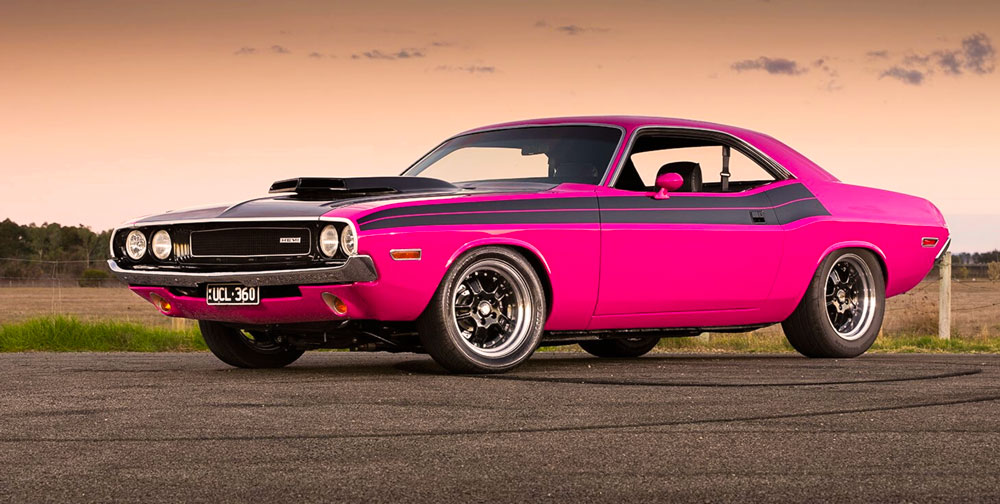
The T/A represents a fascinating alternative to the traditional muscle-car formula. It did not attempt to overpower the Hemi or challenge the 440 Six Pack at its own game. Instead, Dodge created a more agile Challenger with a responsive small-block, specialized chassis hardware and a direct connection to professional road racing.
Its imperfections are part of the appeal. The carburetors require careful adjustment, the staggered tires did not magically erase the Challenger’s size, and the side exhaust is unlikely to make friends during an early-morning departure. But the car feels mechanical, theatrical and entirely committed to its moment.
MaxTake
The 1970 Challenger T/A was not the most powerful Mopar of its era, but it may have been one of the most charismatic. Its 340 Six Pack, competition-inspired hardware and unforgettable stance created a muscle car that looked toward the road course without surrendering its street presence.
More than half a century later, the T/A remains a reminder that performance is not always about having the largest engine. Sometimes the most memorable car is the one with the clearest attitude.